Wednesday, February 20, 2013

Ghost in the Shell

Ah, Ghost in the Shell, a memento from my childhood, though I didn't understand the complex plot and boring political banter at the time I still loved it because it represented something special to me: night.  I used to sneak out of bed in the middle of the night and watch anime on the movie channels of satellite TV as a child with the volume extremely low.  Anime always came on late at night for some reason, probably partly due to the mature nature of what was shown and the fact that most anime fans were night owls anyway so Showtime could successfully market to them without alienating the mainstream watchers.  Whatever the reason, as a child anime symbolized late night (at the time roughly 1:00-3:00 AM which is early for me now) because late night was my time.  Everything was silent and dark and only the flicker of the big CRT TV with the volume barely audible from a foot away (I didn't want to wake up my parents and be sent back to bed) and in a way those nights were almost romantic in their nostalgia.  I ran across a few gems of the medium as well at the time such as Bubblegum Crisis, Gunsmith Cats, Cowboy Bebop, Ninja Scroll, and of course Ghost in the Shell.  One of my favorite things about Ghost in the Shell is that it truly is a science fiction movie (rather than a science fantasy movie like say Star Wars) [for anyone who does not know the difference science fiction is always focused on technology including how it works, how it changes things, and how it fits into our lives, science fiction is almost always based strongly in reality on current or potential technology, whereas science fantasy tells a story in a futuristic setting and simply explains "magic" by saying "because science!"].


As a child I liked Ghost in the Shell because it represented freedom, it represented maturity, and most of all it represented staying up late without my parents knowing.  On top of that the unusually dark (for my experience) science fiction setting was an interesting change and the cool gadgetry of the world intrigued me. As an adult I like the movie for different reasons (although those original reasons still apply too, go staying up way too late without my parents knowing even though I'm an adult!), mainly because it has an extremely interesting plot despite being a bit over-complicated by political banter which is used to set up the background story.  To put it simply: Ghost in the Shell is the anime equivalent of Blade Runner.  What I mean by that is they both ask similar moral questions.  But, for simplicity the plot revolves around a group of counter-terrorists who specialize in cyber terrorism and are led by Major Motoko Kusanagi, who is probably my favorite female character in anything ever.


As a character Major Kusanagi is very quiet and stoic, she talks during the movie with the people who are around her because she knows and and trusts them but seems to rarely talk unless necessary and when she does she is very efficient with her words.  She doesn't have much respect for authority but she does have respect for those around her, including her superiors and her subordinates.  She respects people rather than positions.  The word efficient is probably the best way to describe her because her personality is like a well-oiled machine (which is intentional but more on that later).  Watching her in action scenes is incredible because the animators made sure to imbue her with a sense of power and, again, efficiency.  The way she runs: taking steps just long enough to not be cumbersome and not moving any other part of her body, the way she shoots: double tap with straight, realistic aiming, and pinpoint precision, and everything about her scream perfection.  She is someone who is very careful with how she moves and controls herself and makes sure every action is perfect, almost like a machine.  This is interesting because she is a machine!  Mostly.  She has part of a human brain inside of a cyber-brain enclosure that provides increased thinking and information processing capabilities as well as networked links to connect to the internet, and the brain is stored inside an entirely cybernetic body.  The title suddenly becomes clear here, Ghost in the Shell is in reference to her, the partial human brain is where her creativity, instinct, and human soul come from, i.e the ghost, and the cybernetic body is the shell.  However, in the world of Ghost in the Shell fully cybernetic and partially cybernetic humans are the norm and the only thing that sets her apart from most people is that she has a extremely expensive body with a lot of capabilities because she works for the government in a job where she would definitely need those enhancements.


In fact, nearly everyone has some sort of cybernetic enhancement in this world, even Togusa who is the only member of the anti-terrorist team that is almost entirely human (his only cybernetic enhancement is a brain augmentation that allows him to connect to communication systems such as the internet).  The movie adequately explores the dangers of these enhancements through a practice called "Ghost hacking" in which a hacker will break into the cyber brain of an individual and either take control of the persons body or mess around with their memories.  Both instances happen in this movie, in one situation a senators assistant is hacked into in order to force her to assassinate the senator and in another instance a mans memories are replaced which leads him to committing crimes he doesn't realize he's committing.  The movie, and the TV series Ghost in the Shell: Stand Alone Complex investigate the possibilities both good and evil in great depth.

As far as plot goes Section 9 (the aforementioned anti-terrorist team) is given the assignment of hunting down a hacker known as The Puppet Master.  The name The Puppet Master comes from the fact that he ghost hacks people and uses them as human proxies to ghost hack other people.  He has a whole series of these ghost hacked puppets which he uses to commit various crimes and due to the way he has some puppets hack other people to turn them into his puppets he is very hard to trace because even if the team captures a cyber brain in the process of being ghost hacked it will only lead to another puppet.  The setup is both eloquent and complex and the sort of person who could control such a system must be incredibly intelligent and calculating, a great foil the the Major herself.  So what we have is a spy thriller about a cyber criminal, but it is also a great personal journey for Major Kusanagi because she has been in a cybernetic body so long that she has no memories of when she was a human.  In fact, she doesn't even know for sure if she has actual human brain cells in her cyber brain and so throughout the film she is seeking an answer to whether or not she really is human.  One particularly good scene involves her going scuba diving with one of her close friends and subordinates, Batuo, after having seen someone else with the same cybernetic body as her earlier in the day which made her question her individuality.  She states that she can let herself go when she scuba dives and the conversation that she and Batuo have about both their individuality and their cybernetic bodies is extremely well presented.  She really comes across as someone who has been so focused on making her professional life perfect that she forgot who she was on a personal level.  She is an extremely strong, independent woman who knows her place in the world, but doesn't know who she really is or if she is even human.  She is quite a well developed and subtle character.


The movie also has a few action scenes that are sporadic but extremely realistic in their presentation (based on the rules of the world) and while the movie does have several scenes with grotesque violence, the violence is there for a reason, not just to shock.  Ghost in the Shell is outstanding and, considering most of the scenes are incredibly simple, they work perfectly.  Overall the main character is extremely interesting as is the villain, and both are products of the well-realized and eerie world of future Japan.  This film is an absolute must-see for any fans of science fiction, crime drama, or action.

Verdict
9/10

Wednesday, January 9, 2013

Donnie Darko and Donnie Darko Director's Cut: Part 2

Last week I talked about the fairly good, if overly confusing, movie Donnie Darko.  The biggest complaint I had was that the movie did almost nothing to clue the audience in to what was actually happening in the plot or why it was important.  The Director's Cut not only completely solves this problem, it does so without losing the feeling of mystery that the theatrical version had.  The Director's Cut also takes the characters that were so good in the theatrical version and makes them even better while it cryptically reveals why everybody is acting so quirky and unusual.


The biggest strength of Donnie Darko Director's Cut is that, while it reveals enough information to figure everything out, it reveals it slowly and deliberately.  On top of that, it still leaves enough out that the audience has to draw their own conclusions about specifics, however they now have the tools to do so.  Plus, this movie doesn't skimp on the importance: in an early scene Gretchen says to Donnie "Donnie Darko?   What kind of a name is that?  It sounds like some sort of super hero."  To which Donnie replies, "What makes you think I'm not?"  In the theatrical version this scene just comes off as harmless flirting because we never know what is actually going on, however in the Director's Cut, especially when watching it for a second time, the audience may chuckle a bit as they get the joke.


I know the article isn't very long this week, but honestly there isn't too much to say about Donnie Darko Director's Cut that wasn't already said in the review of the theatrical release.  The movies are very similar to each other, the Director's Cut just tells us the plot, and unfortunately I don't want to talk about that too much so as to not spoil it for anyone.  Needless to say, Donnie Darko Director's Cut is an extremely good movie with quite a complex and very compelling story.  For any fans of cerebral thrillers and science fiction movies I highly recommend Donnie Darko Director's Cut.


Verdict,
9.5/10

Thursday, January 3, 2013

Donnie Darko and Donnie Darko Director's Cut: Part 1

Donnie Darko is a movie I saw three years ago for the first time.  I remember watching it twice and even after the second watch having no idea what the hell was going on in the movie.  The overarching plot about time travel didn't seem to make any sense, there were a few things here and there that I caught on to but overall I had no idea what to make of it.  That being said I still enjoyed Donnie Darko because of its characters and interactions.  It had a great cast for its time including Jake Gyllenhaal, Maggie Gyllenhaal, Noah Wyle, Drew Barrymore, Patrick Swayze, and even a young Seth Rogen.


Jake Gyllenhaal is the titular Donnie Darko, a teenage boy who is extremely intelligent but has some rather serious emotional issues.  In the beginning of the film Donnie is a rather unlikable character, seemingly being a jerk to whoever he talks to be it his parents or sisters.  During one early scene in which he smokes a cigarette in front of his younger sister, he threatens to put her hamster in the garbage disposal if she tells their mom about the smoking.  However, as the movie progresses we see that Donnie is actually very likable (at least to me) by being extremely intelligent and logical.  In fact, he seems so out of place with the rest of the characters except his would-be girlfriend Gretchen.  Another early scene shows Donnie hanging out, drinking whiskey, and shooting bottles with his two friends; the friends are talking about a gang bang scenario involving the Smurfs and Smurfette with Papa Smurf filming (this is not a movie for children as it shows "average" teenage guys talking among themselves and as such many of the sexual frustrations of being a teenager are apparent through conversation and other means).  Donnie then proceeds to explain to them in explicit detail exactly why this scenario would not be logical or even possible in the world of the Smurfs.  Donnie has a bit of a rough start but he shortly makes up for it by showing how he is simply an average, albeit very intelligent, teenage boy just trying to find his place in the world and by the end reaches the point of being a strong and respectable, even likable character.

Jake Gyllenhaal gives a phenomenal performance as the awkward teenage boy but he isn't the only strong character.  Jena Malone does an exceptional job in the (more important than you might think) role of the girlfriend while Patrick Swayze does his usual thing as a cheesy '80s public speaker and self-help author.  Drew Barrymore is an English teacher who almost cares too much and Noah Wyle is a science teacher who has a fascination with time travel and guides Donnie through a decent part of the movie.  There are many other characters I could talk about as well that are all very well developed but I think you get the point.


As great as the characters are in Donnie Darko the plot suffers heavily from too much editing.  Think for a minute would you, of any great movie or book you read which had unusual occurrences and strange events that seemed to make no sense but were actually revealed to be extremely important in a handy wrap-up of what happened at the end.  Now, imagine that wrap-up were completely cut out and the viewer is left trying to decipher the incredibly obscure rules of this fictional world.  That's the biggest flaw with Donnie Darko.

The plot of the movie revolves around Donnie and his continual changing perception of his world.  Early in the movie he sleepwalks out of his bed following a 6-foot tall, creepy looking rabbit named Frank.  Frank lures Donnie out of his bed to a golf course where he proceeds to tell Donnie that the world will end in exactly 28 days, 6 hours, 42 minutes, and 12 seconds.  Right about the time this happens a large jet engine falls out of the sky and crashes through the roof of Donnie's house into his bedroom.  If Frank hadn't lured Donnie out of the house he would have been killed by the jet engine.  Throughout the course of the movie Frank asks Donnie to do illegal and dangerous things, things that never physically hurt anyone but that cause other things to happen.  No I'm not going into any more detail than that.  Interesting setup, right?  The problem is that we, the audience, never know what to expect: we have no idea what the goal is, what is at stake, why it's important that Donnie do these things, and where the people of the town all fit into the equation.  And, the answers are never revealed.  The ending is incredibly ambiguous, not as to what happened, but as to why and how it happened.  Nothing seems to make sense and things start happening apparently randomly in the last third of the movie with little or no explanation as to the character motivations other than Donnie's.


Now that we have the strongest and weakest aspects out of the way lets talk about how the movie looks and feels: fantastic.  The whole movie is shot with an off-putting blue lens which does an excellent job of keeping the audience with a feeling of isolation in this world.  All of the characters act a little bit off as if they have something bothering them but don't know what it is.  On top of that there are a few character turns that were completely unexpected but make total sense.  Finally, the whole film was shot as if it were a horror movie, making common use of the empty space technique (I'm sure that isn't what it's actually called but it's where the camera shows a sudden clearing of empty space, an example would be a person leaning down below the camera from a closeup so that the audience has a sudden chance to see the monster standing behind them with claws ready to disembowel).  Every frame of Donnie Darko was shot with a love and care rarely seen in movies and everything feels precise and needed; unfortunately we needed a bit more to actually understand what's going on.

Overall Donnie Darko is a very good movie, but not great, and it's on Netflix.  Normally I would give my recommendation and say "go watch it" and I still say that to the lazy moviegoer who just wants to watch something unusual and refreshing but for those of us willing to go out and find a particular movie I have something better in store for you so you should skip out on Donnie Darko.

Verdict,
7.5/10

This was getting very, very long so I decided to do it in two parts.  Part 2 will cover the movie you should watch if you're willing to go out and find it: Donnie Darko Director's Cut

Thursday, November 15, 2012

Movies by the Book

In my Cloud Atlas review I stated that there were different ways people view movies that are based on books depending on if the person viewing the movie had or hadn't read the book.  Today I'd like to go a bit more in depth about it.  I'm sure we've all heard someone say that they thought a movie was better because it was closer to the book, or liked it less because it deviated from the book significantly, and others say they liked the movie with or without reading the book.  So who is right?  I mean I know it's a subjective question but it is still valid: is a movie based on a book better if it follows the events of the book more closely or is it better if it follows the events of a book more loosely.  The answer, unfortunately, is that there is no answer.


Books and movies are fundamentally different mediums: books are meant to be read over long periods of time, days, weeks, or even months depending on the reader.  Movies however, are meant to be watched in one sitting, generally between ninety minutes and three hours.  The key problem here is pacing.  Books have a tendency to have a lot happen in them, just look at Harry Potter, the first book was a mere three hundred pages, give or take, and it took nearly three hours to make into a movie.  That was the first Harry Potter movie and, aside from one scene, the movie was nearly identical to the book.  Let me say that again, three hours to tell three hundred pages, and the movie wasn't great either.  Due to it's adherence to the book the first Harry Potter movie was riddled with awkward dialogue and over acting, and for it's extend length the movie didn't even even have all that grand of a plot.


Lets compare that with the fifth Harry Potter movie, which removed a considerable portion of the book and added in scenes to fill the gaps with more important, and better presented scenes.  All told the fifth movie was considerably better as a movie than the first.  Yes it still had about a three hour running time, but the story it got through in that three hours was nearly eight hundred pages, and because of the significant editing the movie was presented more like a movie than a book that was just filmed.

Another good example of a movie being made into a book correctly is the Lord of the Rings which is probably the greatest piece of fantasy fiction ever put to film.  And, yes, Lord of the Rings stuck to the books quite well, save for a few moved around scenes and some editing for theaters (the edited content, which was quite significant, was later added in anyway in the Extended Editions, which is a must own for any movie enthusiasts collection), but what it got right was pacing.  Peter Jackson knew that if he rushed through LotR with the same recklessness as was put into the first few Harry Potter movies (which, coincidentally, premiered about the same time as LotR) then they would have the same problems, particularly awkward dialogue and overacting, as well as a hollowness to the story.  So, what did he do right?  Pacing.  It has become sort of a joke that the Lord of the Rings movies are incredibly long, and they absolutely are, but for very good reason: Peter Jackson wanted to make sure the audience had adequate time to get to know all of the characters.  Every single character in the movie is introduced deliberately and effectively.  Remember the first time you meet Aragorn and he's this mysterious ranger calling Strider, that you don't know if he's friend or foe?  Didn't that make you incredibly interested in the character?  And then he saves the hobbits lives and leads them to Rivendell!  Aragorn was an awesome character, and one of the most well introduced characters in the series.


Now we've reached the point of characterization and this is the main reason for the discrepancy between those who have read the book and those who haven't when watching a movie.  PEOPLE WHO HAVE READ THE BOOK ALREADY HAVE AN EMOTIONAL ATTACHMENT TO THE CHARACTERS IN THE BOOK!  Comparatively, those who are watching a movie as an introduction to the story do not have that emotional attachment to the characters.  So, why is this important?  Those who have read the book only want to see the scenes acted out, they already know what's going on in each characters mind as well as what their hopes and dreams are and etc...  They have an emotional attachment to the characters so the movie doesn't have to try and build it up.  Conversely when someone is new to the story and a movie just replays the scenes from the book without giving the audience a way to really get to know the characters, the audience then has no reason to care about the people on screen, or any danger they might be in.  This makes movies flat and boring for anyone who hasn't read the book.


Finally, what is the best way to convey a book in movie form, despite the fact that they're entirely different mediums?  It's simple, though not easy.  Step one is to read the book and decide what the theme and tone of the book are.  Try and figure out what the book is trying to convey to the reader.  Why was this book written, essentially.  Then make damn sure your movie delivers that to the audience.  Step two is to make sure the characters are likable and have human depth.  Flat, one dimensional characters can ruin any movie, no matter how good the plot is.  And finally, step three is to get the events in order.  Add what you can from the book but only as long as it helps the movie say what it needs to say.  Never sacrifice pacing for more scenes from the book, pacing is important and it can make or break a movie.  Don't be afraid to make up your own scenes, if they serve the purpose better than anything in the book they add them and the movie will be better for it.

The key point to remember is that a movie is a movie and a book is a book.  A movie should be taken on its own merits and not on how close to the book it is, so make sure your movie is good for everyone watching, even the ones who haven't read the book.

Friday, October 26, 2012

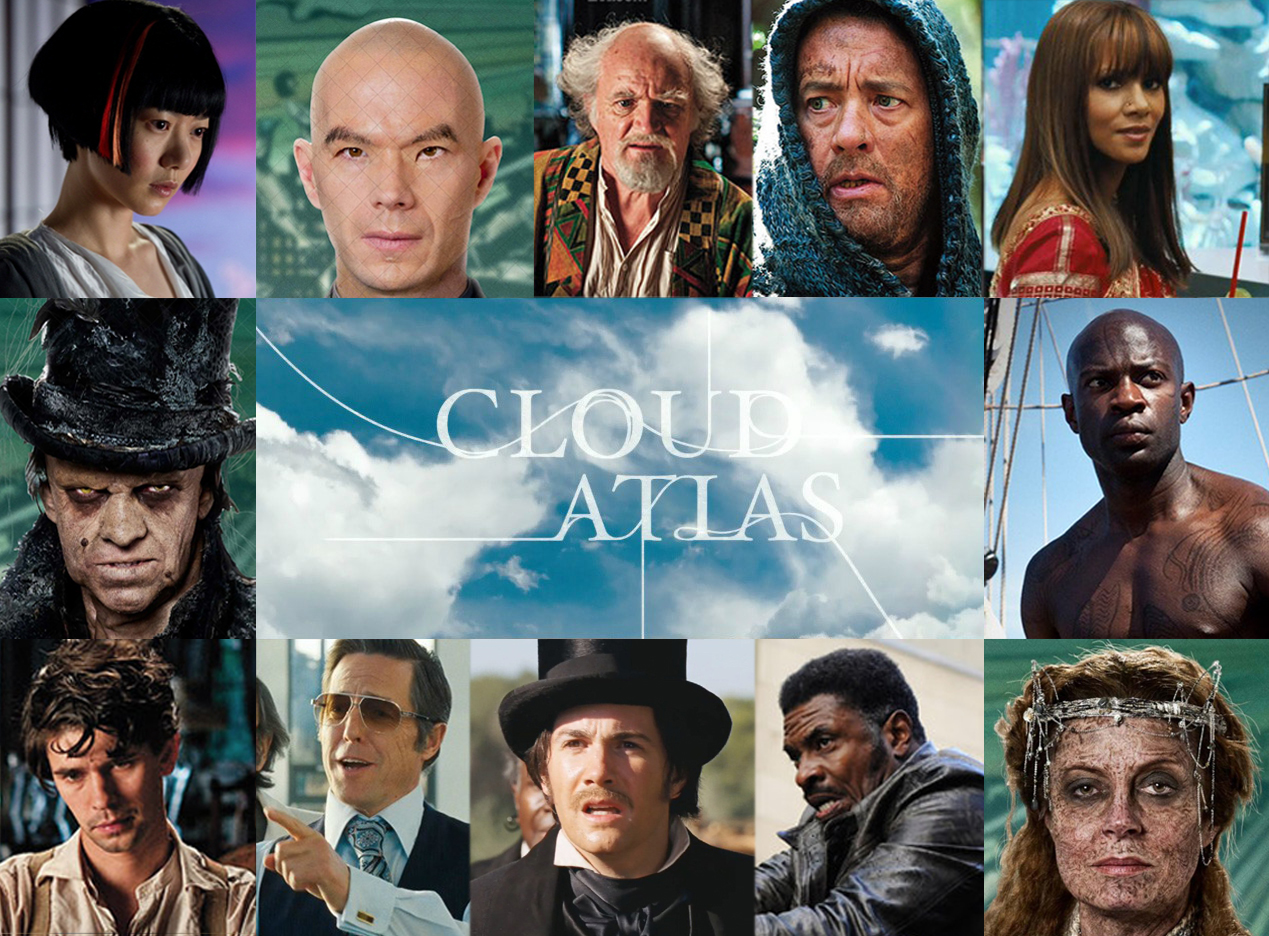
Cloud Atlas

I must admit that I went to see Cloud Atlas expecting to like it, the trailer for the movie showed an expansive, epic, tale spanning multiple generations of human life about how the smallest drop of change can ripple across time affecting the world in ways nobody could ever predict.  The movie that accompanies it delivered exactly what the trailer promised, however I would still consider it a failure, at least partially.


I will admit, I have never read the book of Cloud Atlas and while that may affect my opinion of the movie, I think its effect is a good one because a movie should be judged on its own merits rather than how well it relates to another piece of media.  I will soon write an article on the different expectations of those who have and haven't read a book when watching a movie based on said book, but for now I will say that Cloud Atlas feels like it was made for the people who read the book and not for the ones who didn't.


Don't get me wrong, when Cloud Atlas gets things right, they're amazing.  The cinematography is top notch, with breathtaking special effects.  Fantastic actors portray their characters incredibly well, and considering each actor played upwards of six separate characters, they did an amazing job.  The action scenes are what we would expect from the makers of The Matrix but at the same time they are downplayed because the overarching plot was far more important.


The biggest mistake the filmmakers made (The Wachowski Siblings, for those interested) was ambition.  Cloud Atlas wants to be too many things, and the story it has to tell is far too great for even its' three-hour run time. The reincarnation of lovers spanning six separate lives and twelve separate major characters, not to mention countless important secondary characters with each generation having a singular plot, was a tale that should never have been made into one movie.  This would have done much better as a mini-series with six parts, each part dedicated to one generation because, as it stands, each separate story is only given about thirty minutes.  The stories also vary so much in tone, from goofy and lighthearted, to downright shocking and disturbing, while still playing on the same themes.  The movie has a schizophrenic feeling, as if it can't decide whether it wants to be a thriller, a black comedy, a contemplative drama, a mystery, a spiritual science fantasy, or a work of historical fiction.


Cloud Atlas truly is six, very different, movies in one.  It wants to portray the whole of film making and say "this is human drama, love transcends time" but when it changes so quickly from one story to another, particularly in the big finale, your emotions are pulled in every direction: a scene of humor, then a disturbing revelation, then a fight with the devil, and a melancholic suicide.  Not to mention, each character is given so little screen time that only a few of them have any depth at all, the rest are just one-dimensional epic saviors of humanity.  It's so sad as well because the premise has so much promise (say that ten times fast) and unfortunately it was squandered on a beautiful, if ultimately forgettable, experience.

Cloud Atlas
7.5/10

******UPDATE******

After seeing Cloud Atlas a second time, the movie made quite a bit more sense, as did the pace, everything felt right going in the second time and I was able to appreciate the movie more.  Go see Cloud Atlas, but see it twice!!

Updated Verdict,
Cloud Atlas
9.5/10

Friday, September 21, 2012

Fullmetal Alchemist Comparative

First off: yes, I know Fullmetal Alchemist is a TV series, not a movie, but there are movies made of it, and I want to talk about it so that's enough of a link for me to post it on this blog.  For those who don't know, Fullmetal Alchemist and Fullmetal Alchemist: Brotherhood are two TV series based off of the same series of graphic novels.  Fullmetal Alchemist was the first TV series and the graphic novels were still being written when the series was made so after more or less following the books in the first season of the show, Fullmetal Alchemist radically changed it's second season.  It had an entirely different villain, changing entire character arcs, and basically changing the entire story of the show.  After the first series became incredibly popular, the powers that be decided to make a second series, the graphic novels having now been finished, that followed the story of said graphic novels exactly, albeit slightly more sped up: the result was Fullmetal Alchemist Brotherhood.  Brotherhood was also an incredibly good anime series, and with the raving fandom already following it, the budget for Brotherhood was drastically larger than for the original series.  So which is better?


For those who don't know, the basic story of Fullmetal Alchemist is this: two young brothers, Edward and Alphonse Elric, live in a world where a science called alchemy is the main area of scientific research.  Alchemy allows a person who understand matter to break things down and reconstruct them as something else by drawing a transmutation circle (it's an anime, so it has fantastical "magic" elements).  A transmutation may be anything from converting a tree into a wooden sled, snow into ice blocks, a steel rod into a sword, and so on and so forth.  However, alchemy has rules, the most important being equivalent exchange, you cannot gain something without losing something of equal value: in order to make that sled you must have all the wood necessary from the tree, the ice block may only consist of the water in the snow.  The story starts when the two brothers father, who is a genius at alchemy, disappears and they live with their mother for a few years, but their mother contracts a terrible disease and dies when the boys are only ten and eleven years old (Edward being one year older than Alphonse).  The boys, who were already naturally gifted at alchemy, find a teacher to study serious alchemy, the true science behind it.


After several years of study and training the boys attempt to bring their mother back to life with alchemy, using all of the elements that exist in the human body, as well as a drop of their blood each in exchange for their mothers soul.  But, the transmutation backfires and Edward's leg is taken as payment and Alphonse's whole body is taken.  In a desperate attempt to save the life of his brother, Edward uses his arm as payment to pull his brother's soul back from the gate to the afterlife, before it crossed over, and attach it to a suit of armor.  A year later, after Ed has been fitted with mechanical limbs to replace his lost arm and leg, he joins the ranks of the State Alchemists: militant soldiers and researches who are all incredibly gifted, almost genius, alchemists.  Using his state title and research grants he and Al begin searching for the legendary Philosopher's Stone, a substance that supposedly grants the holder the ability to bypass the law of equivalent exchange in alchemy.  Their journey is the main story of the show, that was just the first three episodes (sorry for the long description, but it was necessary).


The first thing I want to compare between the two series is tone:  Fullmetal Alchemist, particularly in the second season, is incredibly dark: Ed and Al face mass murderers, monsters that embody humanly sins, incredible atrocities committed by the military, and the darkest extents of human depravity.  Brotherhood has many of the same themes but comparatively the original series has a bleakness and sense of hopelessness that Brotherhood, which follows the theme of hope stays away from.  In terms of length Brotherhood thirteen episodes longer than Fullmetal Alchemist, but because of the scale of it's story it moves far more quickly.  About halfway through Fullmetal Alchemist, around episode twenty-five a major character is murdered, this same event happens in episode ten of Brotherhood, and it just doesn't carry the same emotional weight as it did in the original.  Not to mention that a lot of the early episodes of the original series which could have been considered "filler" turned out to actually be important because they gave the audience a sense of who the Elric brothers were as people, whereas Brotherhood skims right past them expecting the audience to already be connected to the Elric brothers.  Due to the increased budget, the animation and action in Brotherhood is like night and day when compared to Fullmetal Alchemist.  Brotherhood is far more visually pleasing, but the original series, in my opinion, has a better, more personal story, and better pacing.  Overall I liked Fullmetal Alchemist more than I liked Fullmetal Alchemist Brotherhood.


Both series have a movie as well, Fullmetal Alchemist has Fullmetal Alchemist: the Conquerer of Shamballa while Fullmetal Alchemist Brotherhood has Fullmetal Alchemist: the Sacred Star of Milos.  Between the two movies, Conquerer of Shamballa is undoubtedly the better of them.  It serves as a capstone to the original series, finishing the story and showing the final fates of the Elric brothers as well as all of the other characters.  The movie also has a noticeably dark tone, just like Fullmetal Alchemist and takes place in our own history, in Berlin, Germany in the 1930's.  Conquerer of Shamballa provides a satisfying conclusion to the series.  The Sacred Star of Milos however, is a singular story, only tangentially connected to Brotherhood.  In fact, I haven't been able to find out where in the storyline of Brotherhood the movie takes place, and the side characters that show up in it are basically cameos.  Now, don't get me wrong, it's a fairly good movie, but not up to what I've come to expect in quality from the rest of the Fullmetal Alchemist universe.

Overall
Fullmetal Alchemist
9.5/10
Fullmetal Alchemist Brotherhood
9/10
Fullmetal Alchemist: the Conquerer of Shamballa
9.5/10
Fullmetal Alchemist: the Sacred Star of Milos
8/10

Wednesday, September 5, 2012

Paranorman

Either I've become very good at picking out movies that I think I will like, or I've gotten very lucky.  Paranorman is a stop-motion movie about a young boy named Norman who's obsessed with horror movies and can also see ghosts.  Right off the bat one of the things I liked about this movie is that Norman doesn't have to go through that whole awkward section of realizing he can see ghosts and at first being afraid and then getting used to it and finally using that ability to confront the big baddie; from the very start Norman has pretty much accepted and come to terms with his ghostey-vision.  In fact, it seems as if Norman is more comfortable around ghosts than he is around living people.


The real story starts when Norman's uncle, who can also see ghosts, visits him, nearly dying, to pass on to Norman the duty of keeping the town safe from a curse cast on it by a witch a few hundred years ago.  Norman fails and now zombies are running loose in the town so Norman must put things right.  Paranorman is a childrens movie and that being said it's laugh out loud funny.  Seriously, I actually burst out laughing in the theater at a few parts, but it's also very dark, particularly when the zombies get to town.  Seriously, this movie has scenes of on-screen death as well as the some of the most shameless hate since American History X.


Paranorman seems to be almost a satire of other horror movies however because one of the main themes is fear, or more precicely, the horrors that people can commit when they're afraid.  Considering Norman is a horror movie junkie (much like myself) he seems to be the perfect character to drive this point home, we have to overcome our fear of the unknown so as to not do something harmful.

Up to this point I've only talked about the story so now I want to talk about the animation and how fantastic it is.  Thanks to the help of modern 3D printers, all of the characters have a huge variety of facial expressions and move far more fluidly than just about any other stop-motion film ever made (thats right Nightmare Before Christmas, I'm calling you out).  On top of that it has some of the best use of 3D in the theater since Avatar, particularly one scene which takes place on a tree floating through a void.

Overall do not miss Paranorman, a great childrens movie, and just a great movie all around.
8.5/10