Friday, October 26, 2012

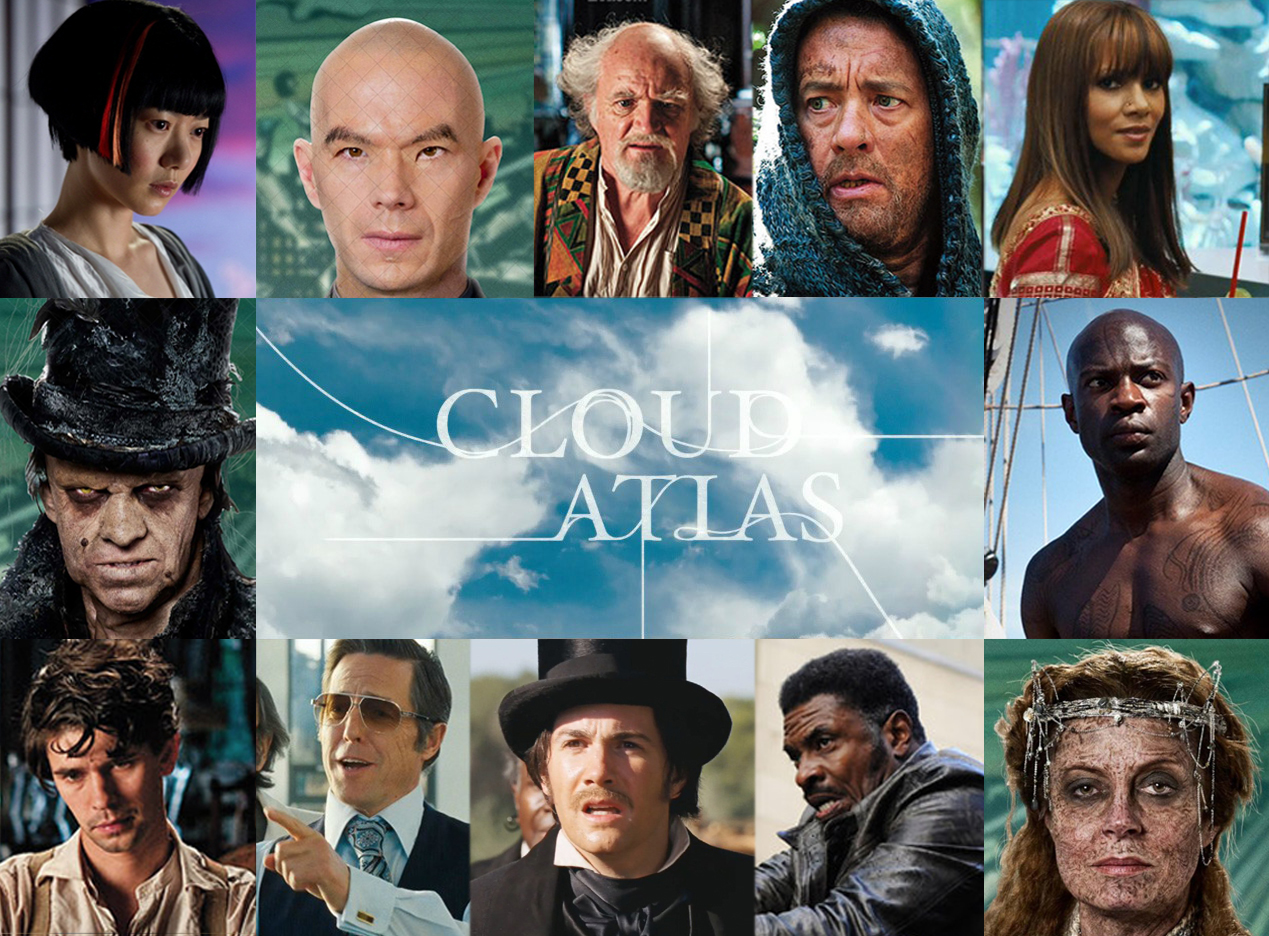
Cloud Atlas

I must admit that I went to see Cloud Atlas expecting to like it, the trailer for the movie showed an expansive, epic, tale spanning multiple generations of human life about how the smallest drop of change can ripple across time affecting the world in ways nobody could ever predict.  The movie that accompanies it delivered exactly what the trailer promised, however I would still consider it a failure, at least partially.


I will admit, I have never read the book of Cloud Atlas and while that may affect my opinion of the movie, I think its effect is a good one because a movie should be judged on its own merits rather than how well it relates to another piece of media.  I will soon write an article on the different expectations of those who have and haven't read a book when watching a movie based on said book, but for now I will say that Cloud Atlas feels like it was made for the people who read the book and not for the ones who didn't.


Don't get me wrong, when Cloud Atlas gets things right, they're amazing.  The cinematography is top notch, with breathtaking special effects.  Fantastic actors portray their characters incredibly well, and considering each actor played upwards of six separate characters, they did an amazing job.  The action scenes are what we would expect from the makers of The Matrix but at the same time they are downplayed because the overarching plot was far more important.


The biggest mistake the filmmakers made (The Wachowski Siblings, for those interested) was ambition.  Cloud Atlas wants to be too many things, and the story it has to tell is far too great for even its' three-hour run time. The reincarnation of lovers spanning six separate lives and twelve separate major characters, not to mention countless important secondary characters with each generation having a singular plot, was a tale that should never have been made into one movie.  This would have done much better as a mini-series with six parts, each part dedicated to one generation because, as it stands, each separate story is only given about thirty minutes.  The stories also vary so much in tone, from goofy and lighthearted, to downright shocking and disturbing, while still playing on the same themes.  The movie has a schizophrenic feeling, as if it can't decide whether it wants to be a thriller, a black comedy, a contemplative drama, a mystery, a spiritual science fantasy, or a work of historical fiction.


Cloud Atlas truly is six, very different, movies in one.  It wants to portray the whole of film making and say "this is human drama, love transcends time" but when it changes so quickly from one story to another, particularly in the big finale, your emotions are pulled in every direction: a scene of humor, then a disturbing revelation, then a fight with the devil, and a melancholic suicide.  Not to mention, each character is given so little screen time that only a few of them have any depth at all, the rest are just one-dimensional epic saviors of humanity.  It's so sad as well because the premise has so much promise (say that ten times fast) and unfortunately it was squandered on a beautiful, if ultimately forgettable, experience.

Cloud Atlas
7.5/10

******UPDATE******

After seeing Cloud Atlas a second time, the movie made quite a bit more sense, as did the pace, everything felt right going in the second time and I was able to appreciate the movie more.  Go see Cloud Atlas, but see it twice!!

Updated Verdict,
Cloud Atlas
9.5/10

Friday, September 21, 2012

Fullmetal Alchemist Comparative

First off: yes, I know Fullmetal Alchemist is a TV series, not a movie, but there are movies made of it, and I want to talk about it so that's enough of a link for me to post it on this blog.  For those who don't know, Fullmetal Alchemist and Fullmetal Alchemist: Brotherhood are two TV series based off of the same series of graphic novels.  Fullmetal Alchemist was the first TV series and the graphic novels were still being written when the series was made so after more or less following the books in the first season of the show, Fullmetal Alchemist radically changed it's second season.  It had an entirely different villain, changing entire character arcs, and basically changing the entire story of the show.  After the first series became incredibly popular, the powers that be decided to make a second series, the graphic novels having now been finished, that followed the story of said graphic novels exactly, albeit slightly more sped up: the result was Fullmetal Alchemist Brotherhood.  Brotherhood was also an incredibly good anime series, and with the raving fandom already following it, the budget for Brotherhood was drastically larger than for the original series.  So which is better?


For those who don't know, the basic story of Fullmetal Alchemist is this: two young brothers, Edward and Alphonse Elric, live in a world where a science called alchemy is the main area of scientific research.  Alchemy allows a person who understand matter to break things down and reconstruct them as something else by drawing a transmutation circle (it's an anime, so it has fantastical "magic" elements).  A transmutation may be anything from converting a tree into a wooden sled, snow into ice blocks, a steel rod into a sword, and so on and so forth.  However, alchemy has rules, the most important being equivalent exchange, you cannot gain something without losing something of equal value: in order to make that sled you must have all the wood necessary from the tree, the ice block may only consist of the water in the snow.  The story starts when the two brothers father, who is a genius at alchemy, disappears and they live with their mother for a few years, but their mother contracts a terrible disease and dies when the boys are only ten and eleven years old (Edward being one year older than Alphonse).  The boys, who were already naturally gifted at alchemy, find a teacher to study serious alchemy, the true science behind it.


After several years of study and training the boys attempt to bring their mother back to life with alchemy, using all of the elements that exist in the human body, as well as a drop of their blood each in exchange for their mothers soul.  But, the transmutation backfires and Edward's leg is taken as payment and Alphonse's whole body is taken.  In a desperate attempt to save the life of his brother, Edward uses his arm as payment to pull his brother's soul back from the gate to the afterlife, before it crossed over, and attach it to a suit of armor.  A year later, after Ed has been fitted with mechanical limbs to replace his lost arm and leg, he joins the ranks of the State Alchemists: militant soldiers and researches who are all incredibly gifted, almost genius, alchemists.  Using his state title and research grants he and Al begin searching for the legendary Philosopher's Stone, a substance that supposedly grants the holder the ability to bypass the law of equivalent exchange in alchemy.  Their journey is the main story of the show, that was just the first three episodes (sorry for the long description, but it was necessary).


The first thing I want to compare between the two series is tone:  Fullmetal Alchemist, particularly in the second season, is incredibly dark: Ed and Al face mass murderers, monsters that embody humanly sins, incredible atrocities committed by the military, and the darkest extents of human depravity.  Brotherhood has many of the same themes but comparatively the original series has a bleakness and sense of hopelessness that Brotherhood, which follows the theme of hope stays away from.  In terms of length Brotherhood thirteen episodes longer than Fullmetal Alchemist, but because of the scale of it's story it moves far more quickly.  About halfway through Fullmetal Alchemist, around episode twenty-five a major character is murdered, this same event happens in episode ten of Brotherhood, and it just doesn't carry the same emotional weight as it did in the original.  Not to mention that a lot of the early episodes of the original series which could have been considered "filler" turned out to actually be important because they gave the audience a sense of who the Elric brothers were as people, whereas Brotherhood skims right past them expecting the audience to already be connected to the Elric brothers.  Due to the increased budget, the animation and action in Brotherhood is like night and day when compared to Fullmetal Alchemist.  Brotherhood is far more visually pleasing, but the original series, in my opinion, has a better, more personal story, and better pacing.  Overall I liked Fullmetal Alchemist more than I liked Fullmetal Alchemist Brotherhood.


Both series have a movie as well, Fullmetal Alchemist has Fullmetal Alchemist: the Conquerer of Shamballa while Fullmetal Alchemist Brotherhood has Fullmetal Alchemist: the Sacred Star of Milos.  Between the two movies, Conquerer of Shamballa is undoubtedly the better of them.  It serves as a capstone to the original series, finishing the story and showing the final fates of the Elric brothers as well as all of the other characters.  The movie also has a noticeably dark tone, just like Fullmetal Alchemist and takes place in our own history, in Berlin, Germany in the 1930's.  Conquerer of Shamballa provides a satisfying conclusion to the series.  The Sacred Star of Milos however, is a singular story, only tangentially connected to Brotherhood.  In fact, I haven't been able to find out where in the storyline of Brotherhood the movie takes place, and the side characters that show up in it are basically cameos.  Now, don't get me wrong, it's a fairly good movie, but not up to what I've come to expect in quality from the rest of the Fullmetal Alchemist universe.

Overall
Fullmetal Alchemist
9.5/10
Fullmetal Alchemist Brotherhood
9/10
Fullmetal Alchemist: the Conquerer of Shamballa
9.5/10
Fullmetal Alchemist: the Sacred Star of Milos
8/10

Wednesday, September 5, 2012

Paranorman

Either I've become very good at picking out movies that I think I will like, or I've gotten very lucky.  Paranorman is a stop-motion movie about a young boy named Norman who's obsessed with horror movies and can also see ghosts.  Right off the bat one of the things I liked about this movie is that Norman doesn't have to go through that whole awkward section of realizing he can see ghosts and at first being afraid and then getting used to it and finally using that ability to confront the big baddie; from the very start Norman has pretty much accepted and come to terms with his ghostey-vision.  In fact, it seems as if Norman is more comfortable around ghosts than he is around living people.


The real story starts when Norman's uncle, who can also see ghosts, visits him, nearly dying, to pass on to Norman the duty of keeping the town safe from a curse cast on it by a witch a few hundred years ago.  Norman fails and now zombies are running loose in the town so Norman must put things right.  Paranorman is a childrens movie and that being said it's laugh out loud funny.  Seriously, I actually burst out laughing in the theater at a few parts, but it's also very dark, particularly when the zombies get to town.  Seriously, this movie has scenes of on-screen death as well as the some of the most shameless hate since American History X.


Paranorman seems to be almost a satire of other horror movies however because one of the main themes is fear, or more precicely, the horrors that people can commit when they're afraid.  Considering Norman is a horror movie junkie (much like myself) he seems to be the perfect character to drive this point home, we have to overcome our fear of the unknown so as to not do something harmful.

Up to this point I've only talked about the story so now I want to talk about the animation and how fantastic it is.  Thanks to the help of modern 3D printers, all of the characters have a huge variety of facial expressions and move far more fluidly than just about any other stop-motion film ever made (thats right Nightmare Before Christmas, I'm calling you out).  On top of that it has some of the best use of 3D in the theater since Avatar, particularly one scene which takes place on a tree floating through a void.

Overall do not miss Paranorman, a great childrens movie, and just a great movie all around.
8.5/10

Saturday, September 1, 2012

Dr. Horrible's Sing-Along Blog

Dr. Horrible's Sing-Along Blog was a short, three-part, internet released film from writer/director Joss Whedon (one of my all time favorite directors, who finally hit mainstream success when he was commissioned to write and direct The Avengers) about a lovelorn super villain by the name of Dr. Horrible (Neil Patrick Harris) who spends his time trying to win the heart of Penny (Felicia Day), the girl of his dreams, and trying to get into the Evil League of Evil (headed by the amazing super villain Bad Horse, who is actually a horse) while being constantly foiled by his arch nemesis Captain Hammer (Nathan Fillion).  To make a long story short Dr. Horrible is AMAZING.  Followers of this blog will notice I have never put that word in all capitals before, the reason I'm doing it now is because Dr. Horrible deserves every bit of recognition it can get.  The movie is a cheesy, light hearted, pseudo-romantic affair about the clashing ideals of the hateful and cynical Dr. Horrible and the world weary but still naive and hopeful Penny.


Let's get the toughest part out of the way: Dr. Horrible is a musical.  Dr. Horrible is a damn good musical!  The music is so good, in fact, that I bought the soundtrack and I am listening to it right now while I write this, and the lyrics are very well written.  "Any dolt with half a brain can see that humankind has gone insane, to the point where I don't know if I'll upset the status quo if I throw poison in the water mien," is one of the best lines I have ever heard in a song written for a movie.  Perhaps I like this movie so much because I can identify so well with the main character; he's dry, cynical, and hateful of people, but he still holds out hope for love and a future with Penny that couldn't exist.


Dr. Horrible is one of my favorite movies ever, I literally watched it three times in a row.  It's light, cheesy, goofy, and it has a pitch-black ending.  Easily the best musical I've seen all year, possibly all decade.  Anyone who enjoys audio/video entertainment of any form should get Dr. Horrible's Sing-Along Blog in front of their eyes as soon as possible.
9.9/10

Tuesday, August 14, 2012

Re-Cycle

I guess it's time for me to do another Asian horror movie.  Today's winner comes courtesy of Taiwan and a very vivid imagination.  Re-Cycle is a psychological horror/thriller/fantasy movie about a writer who gets sucked into a world of abandoned ideas by one of her own abandoned characters.  Some very interesting ideas are going on in this movie because it shows an interesting idea of the afterlife: as long as we remember our loved ones they live through us, but once we forget them they go to the Re-Cycle.  The movie has big ideas and it mostly succeeds in expressing them.


Re-Cycle has a decent, albeit slightly slow, opening with a few scares and a few character points.  Once the main character (who's name I have forgotten since so many of those Taiwanese names are so similar) gets pulled in the world of abandoned ideas though things get interesting.  The scares continue for a bit into the Re-Cycle (which is the world) but they eventually fade away into a darkly toned fantasy story, almost like Alice in Wonderland with aborted fetus's.  Many of the locales in the Re-Cycle are well done but everything has a dark, drab tone that downplays a lot of the beauty.  In fact that drab tone was the worst part of the movie.


Once the movie hits its stride it never feels like it because things never brighten up.  I understand that it's supposed to be a horror movie, but it isn't scary at that point and showing us a grassy hill isn't nearly as calming with a boring grayish-green grass as it would be with pretty, vibrant grass.  Many of the locales are just boring because of it, the decay which is intentionally there doesn't add to the movie viscerally and because of that the exploration of the fantasy environments is pretty boring and seems to drag on.  It is worth noting however that the movie is still a success, the ending is fantastic and is something you won't see coming but totally worth the ride.  Overall give this one a watch, and stick it out through the drab.

7.5/10

Sunday, August 5, 2012

Why Horror Movie Endings Fail At Being Scary

************************************************************************
WARNING: THE FOLLOWING ARTICLE CONTAINS (VERY) MILD SPOILERS FOR PARANORMAL ACTIVITY, PARANORMAL ACTIVITY 3, AND INSIDIOUS
************************************************************************

A trend I've noticed recently in many of the slow-paced horror movies that have come out in the wake of Paranormal Activity is that a lot of them have very poor endings.  The first Paranormal Activity had the perfect ending (I'm referring to the "real" ending, not the theatrical one): in keeping with the slow pace of the movie the ending of the first Paranormal Activity simply had the female lead sit still in a spot while the camera time-lapsed showing days and days passing.  It was simple, boring, and perfect.  But, it wasn't scary.  That ending fit so well with the tone of the movie because Paranormal Activity put the viewer in a constant state of tension without ever delivering on the "boo" scare lesser movies tend to do.  This was brilliant because, as any (good) horror director will tell you, the audiences imagination is their worst enemy.  Nothing that can be shown on screen will ever be as scary as what each member of the audience will imagine.

Now, I know what you're thinking, "but Jeremy, I thought you said the uncanny valley could provide a really scary situation with what it shows on screen."  What I actually said was that the uncanny valley would provide a level of discomfort and could be used to create atmosphere, the actual scares come from the viewers imagination.  Case in point: Insidious.  The uncanny valley effect doesn't really come into play until the end of Insidious but when it does its' purpose is to create a feeling that the entire world is off because it wasn't our world, then our own interpretation is that we don't know what this world is capable of and thus imagine our worst fear.  But I'm getting off topic.


The reason these slow-paced movies ultimately fail in terms of the ending is because, unlike other genres, the climax of this kind of movie has to be different.  Let's look at Paranormal Activity 3 as an example: the whole movie kept the slow pace of the original however it added a few "boo" scares to make the audience jump, they worked reasonably well and escalate at a decent pace throughout most of the movie.  This escalation can't continue exponentially though because the "boo" scares still rely on a slow buildup of tension and by the time we reach the ending the "boo"s are coming at us in rapid fire and thus depriving us the buildup needed to make them effective.  It's quite a conundrum, how do you escalate that kind of movie without resulting to rapid fire "boo" scares?  Change the game.

The most successful horror movie ending that I've seen recently is Insidious because it changes the game for the ending.  The whole movie up to that point has the same buildup curve as the Paranormal Activity movies (although done quite a bit better) and it even had the rapid-fire ending, but it was a fake-out.  The rapid-fire portion of the movie isn't the actual ending, and it's also quite a bit shorter and bigger thus making it more effective than the ending of Paranormal Activity 3.  Insidious changes the game by changing the environment; moving the ending of the movie to the spirit world, or hell as I like to call it, puts a different spin because now the ghosts and demons aren't invisible.  The human spirits are well within the uncanny valley because they seem frozen in their last horrific moments cycling through the same motions over and over.  They become scary in a different way because, as I said above, the viewer doesn't know what they're capable of and while they don't seem to react to the living people at first the spirits slowly catch on the longer they spend in hell.

The main demonic entity is thrown into a new light as well because, instead of being shown as an unimaginable malevolent force, it's a humanoid creature with human tendencies, specifically the tendencies of a serial killer.  The way the demon is characterized in this scene is akin to a combination of Hannibal Lecter and Freddy Kreuger, which works incredibly well with the way his attacks have been happening up to this point in the movie.  Overall the key to this ending being so perfect is that the director increases the excitement without decreasing the tension by throwing scare after scare, he simply slowly reveals the mystery while making the viewer ask more questions.  It works and it works well.  I said this in my original review but it bears repeating here: if you're a fan of horror movies, go see Insidious

Thursday, August 2, 2012

Insidious

Insidious is a movie that did not grab me at first.  The cover art is pretty generic and the tagline "it's not the house that's haunted" nearly made me yawn, and of course proclaiming loudly on the cover that it was from the makers of Paranormal Activity (which I did not like the second or third) was a huge turn-off.  But, after a few days of seeing nothing worth reviewing and hearing mixed opinions about the scariness of Insidious I decided to watch it.  Insidious is great!


The first part of the movie is pretty standard fare for anyone who's seen the Paranormal Activity movies (minus the home camera style filming): a family moves into a new house and strange things start happening, one of the sons falls into an unexplained coma for over three months and the family members, particularly the mother, begin to experience all manner of paranormal activity in the house (haha!).  Not figuring out it's related to their son they move houses and the haunting continues at the new house.  Eventually they call a psychic and find out that their son is what's haunted, not the house.


The biggest difference between Insidious and Paranormal Activity is that Insidious actually pays off all of the tension and building up with a finale that is, quite frankly, glorious.  I think the makers of Insidious just decided to pander to my movie nerd desires because this movie has everything I want in a horror film: tension, atmosphere, a frightening depiction of the afterlife, nerds, and even some comedy.  The ending is something that I will not spoil here but suffice to say it doesn't do what Paranormal Activity does and has a real, semi-conclusive ending.

This is the problem with a good horror film, I don't want to spoil any of the scares or story points, and as such I don't have as much to say as I'd like.  Insidious has an incredibly well done atmosphere and the entity(s) are incredibly well designed and very striking. If you like horror movies, go find a copy of Insidious (it's on Netflix) and watch it.

8.8/10